Distance Estimation of Bok globule CB69
DOI:
https://doi.org/10.22232/stj.2024.12.02.11Keywords:
Dark clouds, Extinction-ISM, Distance-stars, Formation-starsAbstract
Determining the distance of small, opaque dark clouds is particularly challenging due to their compact size. In this research, we have employed the near-infrared (NIR) photometric technique to compute the distance of Bok globule CB69. This method involves estimating the extinction (Av) of field stars using NIR data taken from the 2MASS catalogue, in conjunction with distance data obtained from Gaia. From the extinction (Av) versus distance (d) plot, the stars that exhibit an unexpected rise in extinction are considered the distance of the cloud. Consequently, we have estimated the distance to this CB69 cloud, as approximately 461+4 parsecs, respectively. This value aligns with previously published literature.
References
Barman A, Das H S (2015) Study of grain alignment efficiency and a distance estimate for small globule CB4. Research in Astronomy and Astrophysics 15: 953-962.
Bok B J, Reilly E F (1947) Small Dark Nebulae The Astronomical journal 105:255-257.
Choudhury G B, Das H S, Barman A, Medhi B J (2019) Bok globule CB 17: polarisation, extinction, and distance. Monthly Notices of the Royal Astronomical Society 487: 475-485.
Clemens D P, Barvainis R (1988) The Astrophysical Journal Supplement Series 68, 257.
Clemens D P, Yun J L, Heyer M H (1991) Bok Globules and Small Molecular Clouds: Deep IRAS Photometry and 12CO Spectroscopy. The Astrophysical Journal Supplement Series 75: 877-904.
Colombo D, Rosolowsky E, Duarte-Cabral A, Ginsburg A, Glenn J, Zetterlund E, Hernandez A K, Dempsey J, Currie M J (2019) The integrated properties of the molecular clouds from the JCMT CO(3-2) High-Resolution Survey. Monthly Notices of the Royal Astronomical Society 483: 4291-4340.
Cutri R M, Skrutskie M F, Dyk S van, Beichman C A, Carpenter J M, Chester T, Cambresy L, Evans T, Fowler J, Gizis J, Howard E, Huchra J, Jarrett T, Kopan E L, Kirkpatrick J D, Light R M, Marsh K A, McCallon H, Schneider S, Stiening R, Sykes M, Weinberg M, Wheaton W A, Wheelock S, Zacarias N (2003) Vizier Online Data Catalogue, 2246:0.
Das A, Das H S, Senorita Devi A (2015) Distance estimation of some selected small Bok globules. Monthly Notices of the Royal Astronomical Society 452: 389-396.
Launhardt R, Henning T (1997) Millimetre dust emission from northern Bok globules. Astronomy and Astrophysics 326: 329-346.
Lindegren L, Hernandez J, Bomburn A (2018) Gaia Data Release 2. Astronomy and Astrophysics 616: A2.
Maheswar G, Lee C W, Bhatt H C, Mallik S V, Dib S (2010) A method to determine distances to molecular clouds using near-IR photometry. Astronomy and Astrophysics 509: A44.
Miville-Deschênes M A, Murray N, Lee Eve J (2017) Physical Properties of Molecular Clouds for the Entire Milky Way Disk. The Astrophysical Journal, 834:57-87.
Gaia collaboration (2016) Astronomy and Astrophysics 595, A1.
Gaia collaboration (2022) Astronomy and Astrophysics 667: A148.
Rieke G H, Lebofsky MJ (1985) The Interstellar Extinction Law From 1 To 13 Microns. The Astrophysical Journal, 288:618-621.
Sun M, Jiang B, Yuan H, Li J (2021) The Ultraviolet Extinction Map and Dust Properties at High Galactic Latitude. The Astrophysical Journal Supplement Series, 254:38-49.
Wolf M (1923), Astronomische Nachrichten 219: 109-116.
Yan Qing-Zeng, Zhang Bo, Xu Ye, Guo Sufen, Macquart Jean-Pierre, Tang Zheng-Hong, Walsh Andrew John (2019), Distances to molecular clouds at high galactic latitudes based on Gaia DR2. Astronomy and Astrophysics, 624: A6.
Zuicker Catherine, Speagle Joshua S, Schlafly Edward F, Green Gregory M, Finkbeiner Douglas P, Goodman Alyssa A, Alves João (2019) A Large Catalogue of Accurate Distances to Local Molecular Clouds: The Gaia DR2 Edition. The Astrophysical Journal, 879:125-144.
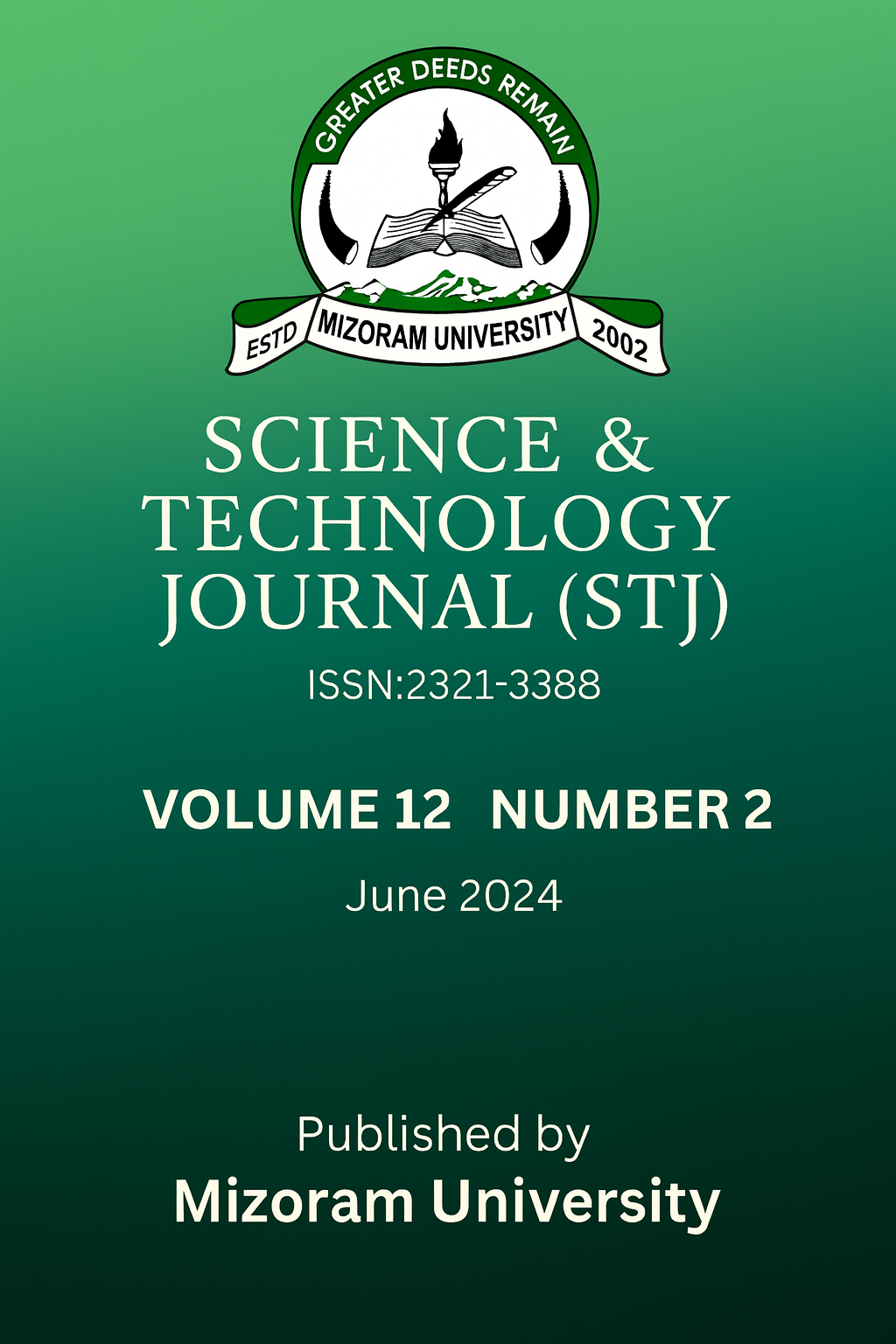
Downloads
Published
How to Cite
Issue
Section
Categories
License
Copyright (c) 2025 R.S. Paul, H.S. Das

This work is licensed under a Creative Commons Attribution 4.0 International License.
© The Author(s) 2025. Published by the Science & Technology Journal (STJ), Mizoram University.
Articles published in this journal are open access and distributed under the terms of the Creative Commons Attribution 4.0 International License (CC BY 4.0).
This license permits unrestricted use, distribution, and reproduction in any medium, provided the original author(s) and source are properly credited.
Authors retain copyright and grant the journal the right of first publication, with the work simultaneously licensed under the CC BY 4.0 license.
License link: Creative Commons Attribution 4.0 International License (CC BY 4.0)
 ORCID – Author IDs for global recognition
 Crossref DOIs – Persistent identifiers
 PKP PN – Preservation via PKP Network
 LOCKSS – Library archiving for permanence
 OpenAIRE – Open Access compliance


 RSS
RSS  Facebook
  LinkedIn